
Chasing Light in the Smokies: A Photographer's Journey Through the Great Smoky Mountains
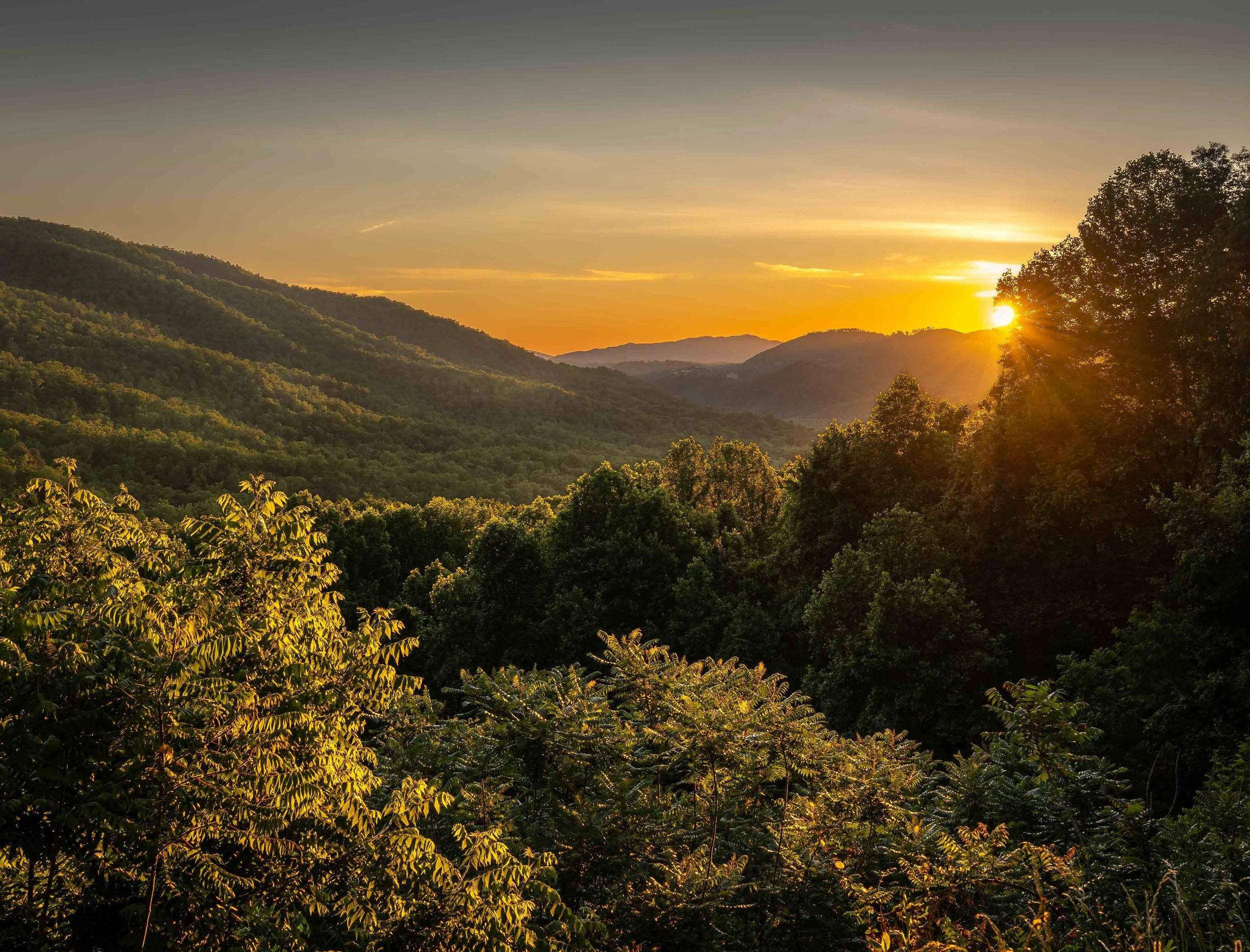
Sunrise in the Smokies
There's a reason the Great Smoky Mountains are the most visited national park in the United States, and it isn't just the easy access from the East Coast. It's the light. It's the way fog pools in the valleys at sunrise like something poured from a pitcher. It's 800+ miles of streams tumbling over moss-covered rock, historic log cabins standing quiet in open meadows, and black bears wandering through it all like they own the place because, honestly, they do.
I recently spent six days photographing the park for the first time, and I came home with a memory card full of images and an even fuller appreciation for why photographers return to the Smokies again and again. This post is part trip report, part photography guide, and part love letter to a park that gave me more good light than I had any right to expect.
A Brief History of the Great Smoky Mountains National Park
Before I ever raised a camera here, the Smokies were home to the Cherokee people for thousands of years, who called the area Shaconage "place of the blue smoke" a nod to the same natural fog and haze that photographers now chase at sunrise. European settlers arrived in the 1800s, building small farming communities throughout the mountains and valleys, many of which left behind the log cabins, churches, and grist mills you can still photograph today.
By the early 20th century, extensive logging threatened to strip the mountains bare. A grassroots campaign funded in part by everyday citizens donating what they could, along with a major gift from John D. Rockefeller Jr. helped establish the Great Smoky Mountains National Park in 1934. Unlike many western parks, the land here had to be purchased and pieced together parcel by parcel, which is part of why the park still holds so many preserved homesteads, cabins, and cemeteries scattered throughout its 522,000 acres.
Today, the park straddles the border of North Carolina and Tennessee and is a UNESCO International Biosphere Reserve, protecting one of the most biodiverse temperate regions on Earth.
Interesting Facts Every Smokies Photographer Should Know
America's most visited national park. The Smokies draw over 12 million visitors a year. More than double the visitation of Grand Canyon or Yellowstone, largely because there's no entrance fee and it's within a day's drive of a huge portion of the U.S. population.
One of the most biodiverse parks in the National Park system, home to over 19,000 documented species, with estimates suggesting tens of thousands more remain unidentified.
The Smokies are old — really old. Geologists estimate these mountains formed over 200 million years ago, making them far older than the Rockies.
The park protects roughly 1,500 black bears, giving it one of the densest bear populations of any place in the eastern U.S.
Synchronous fireflies. For a few weeks each year, one of only a handful of firefly species in the world that flashes in unison puts on a show in the park. A bucket-list subject for a return trip.
Over 90 historic structures are preserved throughout the park, more than any other unit in the National Park System.
Photographic Highlights in Great Smoky Mountains National Park
Sunrise at Luftee Overlook
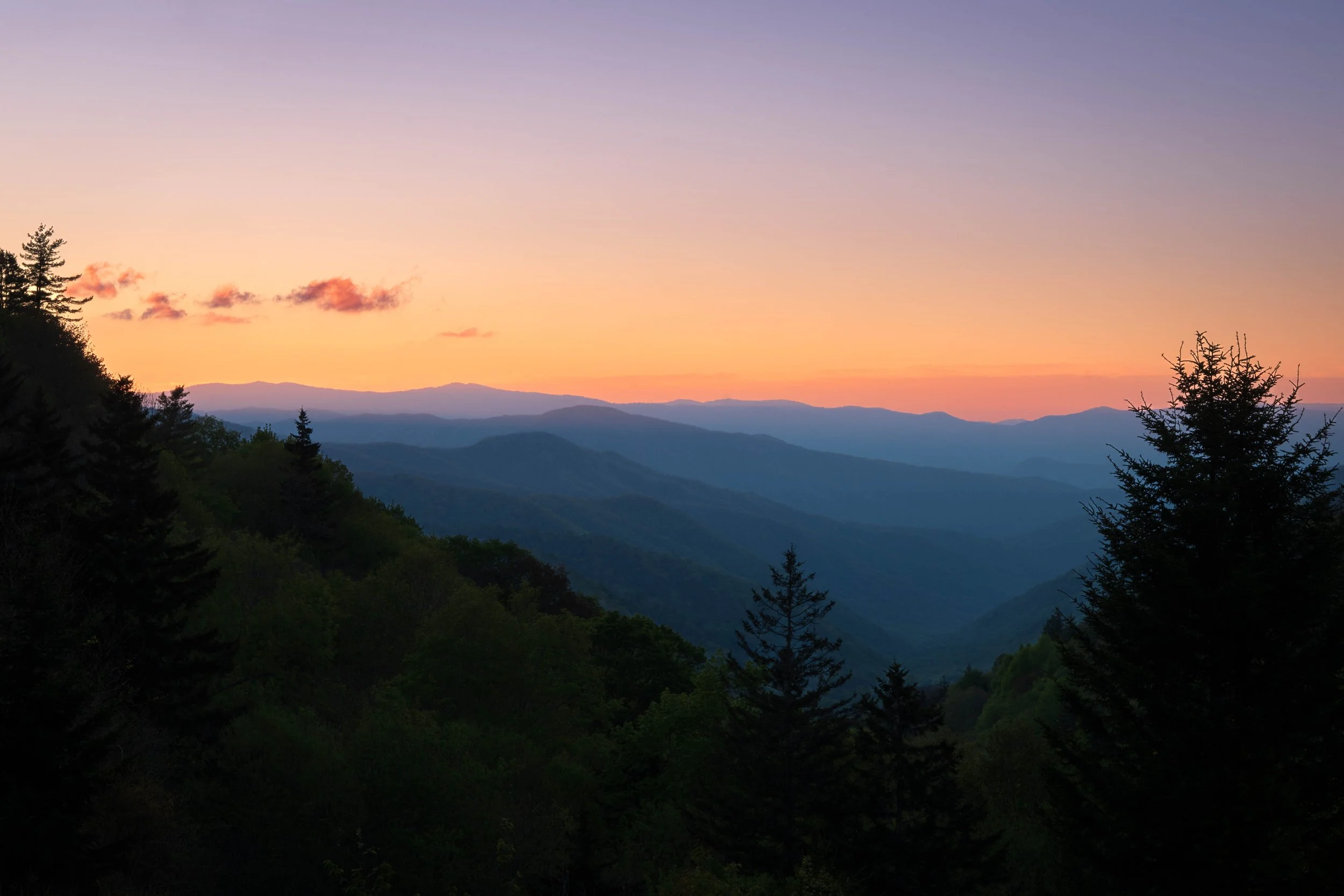
Layer upon layer of ancient ridgeline, wrapped in the smoke that gave these mountains their name.
If you only have one sunrise to give the Smokies, spend it at Luftee Overlook. Located along Newfound Gap Road on the North Carolina side, this pull-off looks out over layered ridgelines that fade from deep green to soft blue-grey as they recede into the distance and the "smoke" the mountains are named for.
I arrived about 45 minutes before sunrise, tripod in hand, and watched the valley below slowly fill with fog while the first light hit the highest ridges in warm gold. The real magic here is patience: the light and fog conditions change minute to minute, so I kept shooting through the entire sunrise rather than packing up after the first good frame.
A few tips if you're planning your own visit:
Arrive in darkness so you can set up before the pre-dawn light starts building.
Bring a longer lens (70-200mm or similar) in addition to your wide angle, compressing the layered ridges makes for a completely different, more intimate shot than the classic wide vista.
A polarizer can help cut haze and add contrast between the ridge-lines, but use it sparingly if fog is present, since too much polarization can flatten the atmospheric effect that makes the shot special in the first place.
The Waterfalls of the Smokies (and Why Cane Creek Twin Falls Stole the Show)
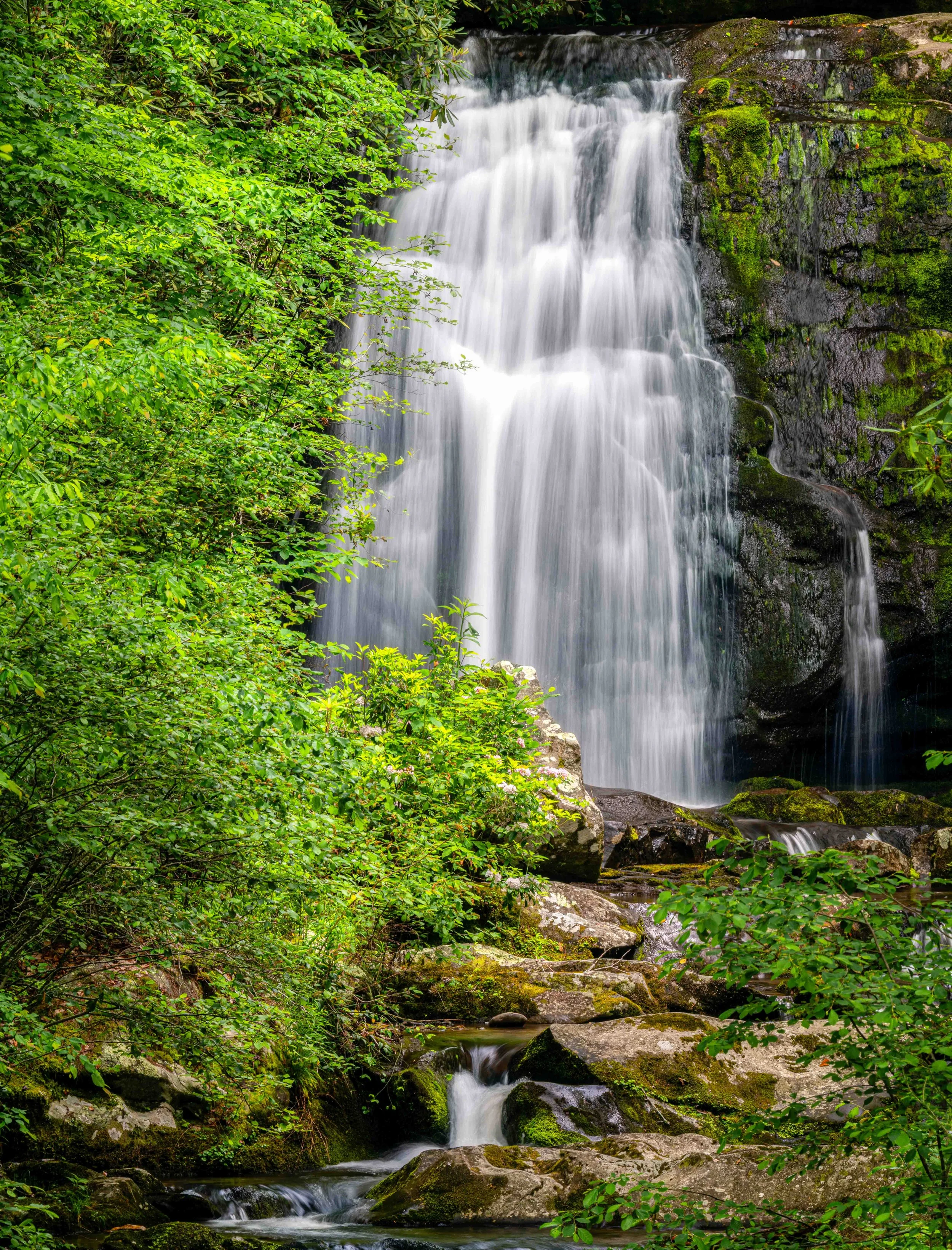
Two falls, one pool, and a forest just beginning to bloom — Cane Creek Twin Falls in late spring.
With more than 2,900 miles of streams running through the park, waterfalls are almost unavoidable and that's a very good problem to have as a photographer. Popular falls like Laurel Falls, Grotto Falls, and Rainbow Falls are well documented and worth the hike, but the one that surprised me most was Cane Creek Twin Falls.
Tucked into a quieter corner of the park, Cane Creek Twin Falls features two distinct cascades dropping side by side into a shared pool, framed by rhododendron and moss-slicked boulders. In May, the rhododendron blooms were just starting to open, adding soft pink accents against the deep greens of the surrounding forest. Because it sees far less foot traffic than the marquee waterfalls, I had long stretches of uninterrupted shooting time, a rare luxury in a park with 12 million annual visitors.
Photographing waterfalls well comes down to a few consistent principles regardless of which falls you're at:
Overcast skies are your friend. Direct sun creates blown-out highlights on the water and harsh contrast in the surrounding forest. Soft, even light lets you capture detail in both the falls and the shadows.
A tripod is non-negotiable if you want the classic soft, flowing water look.
A circular polarizer cuts glare off wet rocks and leaves, and deepens the greens of the forest, arguably even more valuable at waterfalls than at any other subject in the park.
Watch your composition, not just your shutter speed. At Cane Creek Twin Falls specifically, I found the strongest compositions came from getting low near the pool at the base, using the foreground rocks to lead the eye up toward both cascades at once.
Cades Cove: Fog, Cabins, and History Frozen in Time
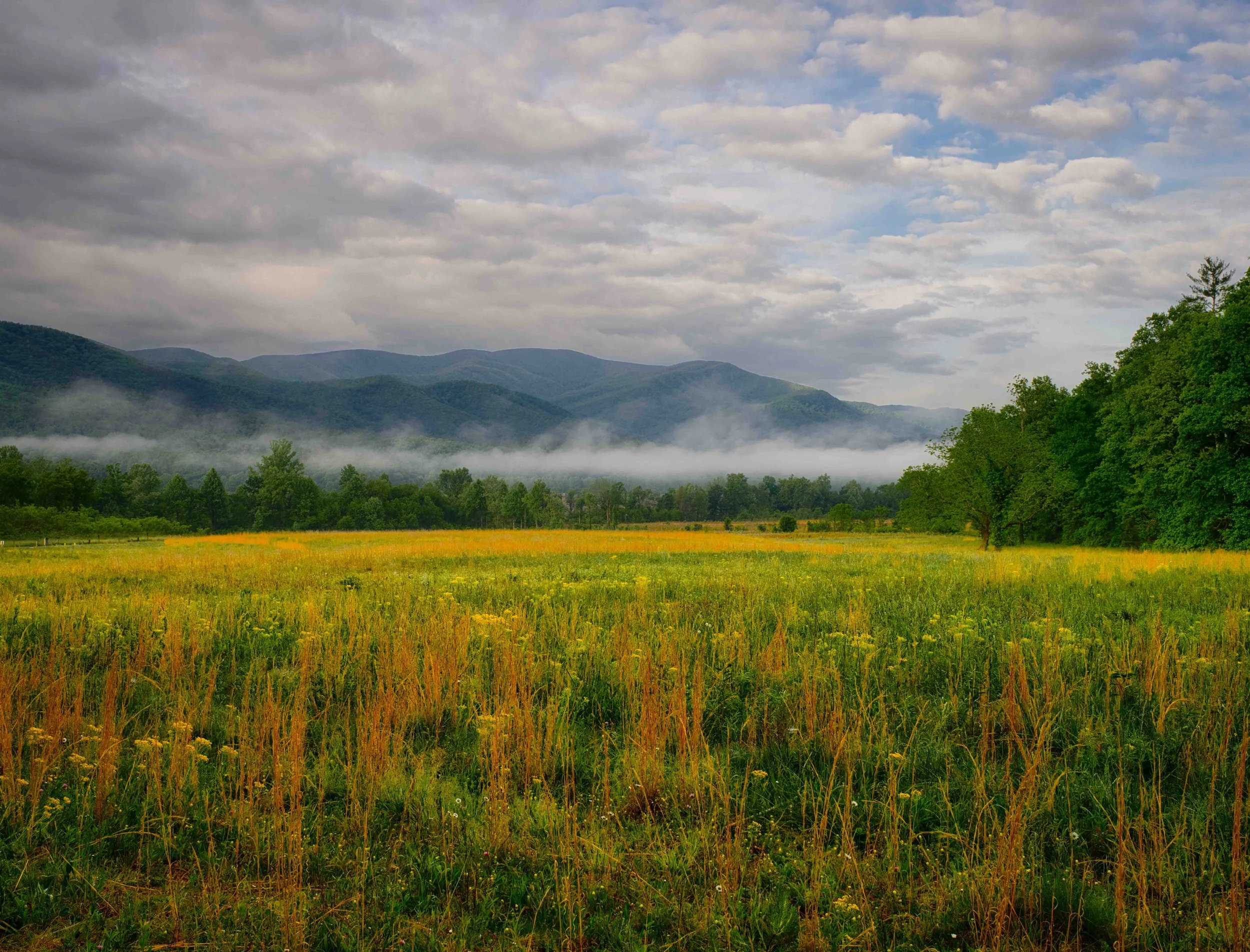
The mist settling in the valley at Cades Cove.
If Luftee Overlook is about grand landscapes, Cades Cove is about intimacy. This broad, flat valley ringed by mountains was once home to a thriving farming community, and the park has preserved churches, barns, and log cabins throughout the loop road that circles the cove.
I got extremely lucky with fog here. Arriving right after sunrise, I watched a low blanket of mist settle over the open fields, with only the tops of distant trees breaking through. Fog in Cades Cove doesn't just add atmosphere it simplifies the scene, stripping away distracting background clutter and letting a single cabin, fence line, or tree stand on its own against a soft, glowing backdrop.
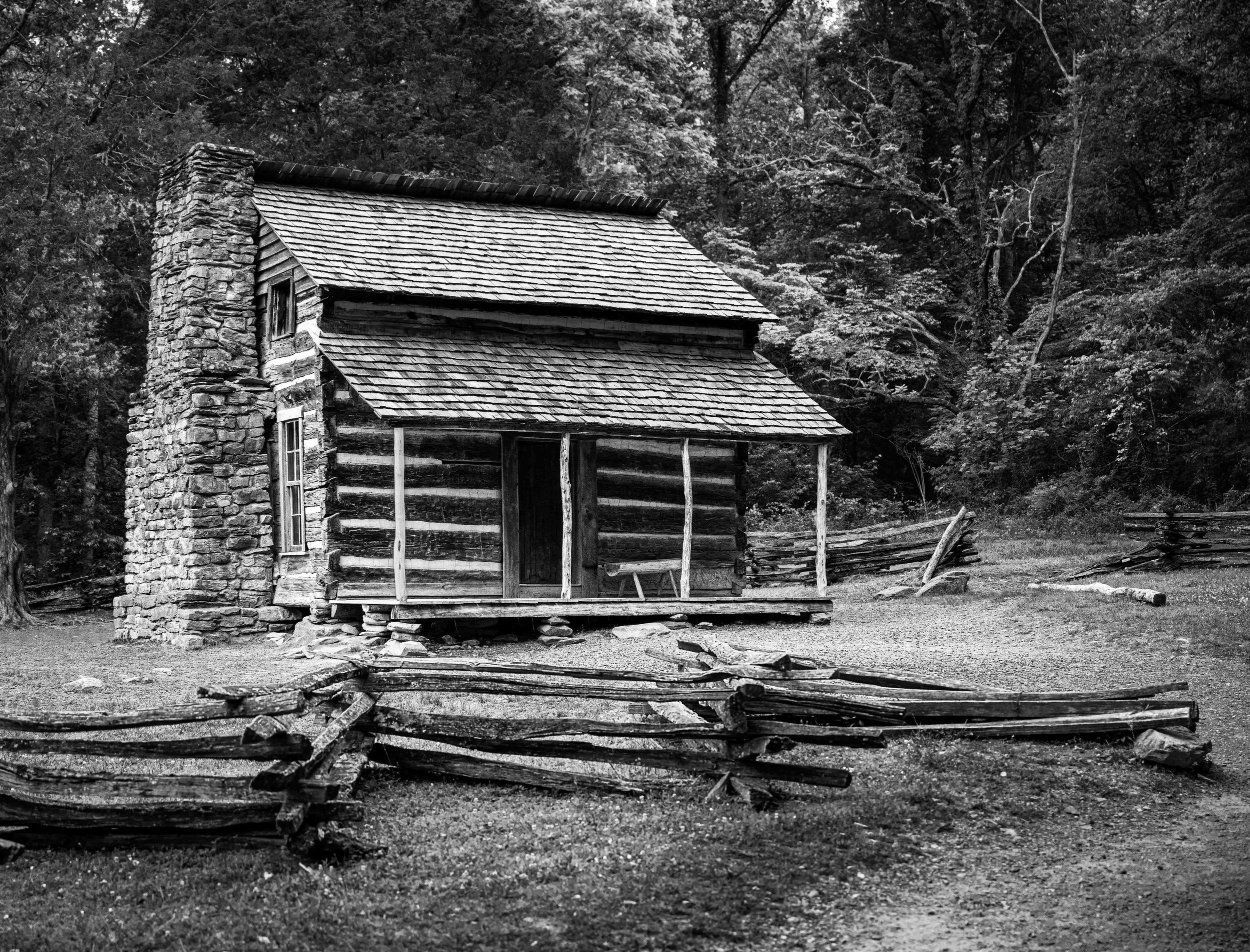
Built in the 1820s and still standing watch over the cove. The John Oliver Cabin, rendered in black and white to let the texture and history speak for themselves.
Of all the historic structures in the cove, the John Oliver Cabin is the oldest and, in my opinion, the most photogenic. Built in the early 1820s by one of the cove's first white settlers, its hand-hewn log construction and simple, symmetrical roofline have a quiet dignity to them.
I chose to photograph this one in black and white specifically because color can sometimes compete with a subject like this rather than support it. A green field and blue sky pull attention away from the texture of the aged wood and the story the structure is telling. Stripping the color out lets the composition focus entirely on line, shadow, and texture: the grain of the logs and the gaps of dark shadow between them.
A few things that helped the black-and-white conversion succeed:
Shooting in early, low-angle light so the raking light raked across the log texture and created strong shadow definition.
In processing, boosting contrast and clarity more aggressively than I would in a color image, since black-and-white photography leans so heavily on tonal separation to create depth.
Silky Rivers: How to Slow Down Moving Water
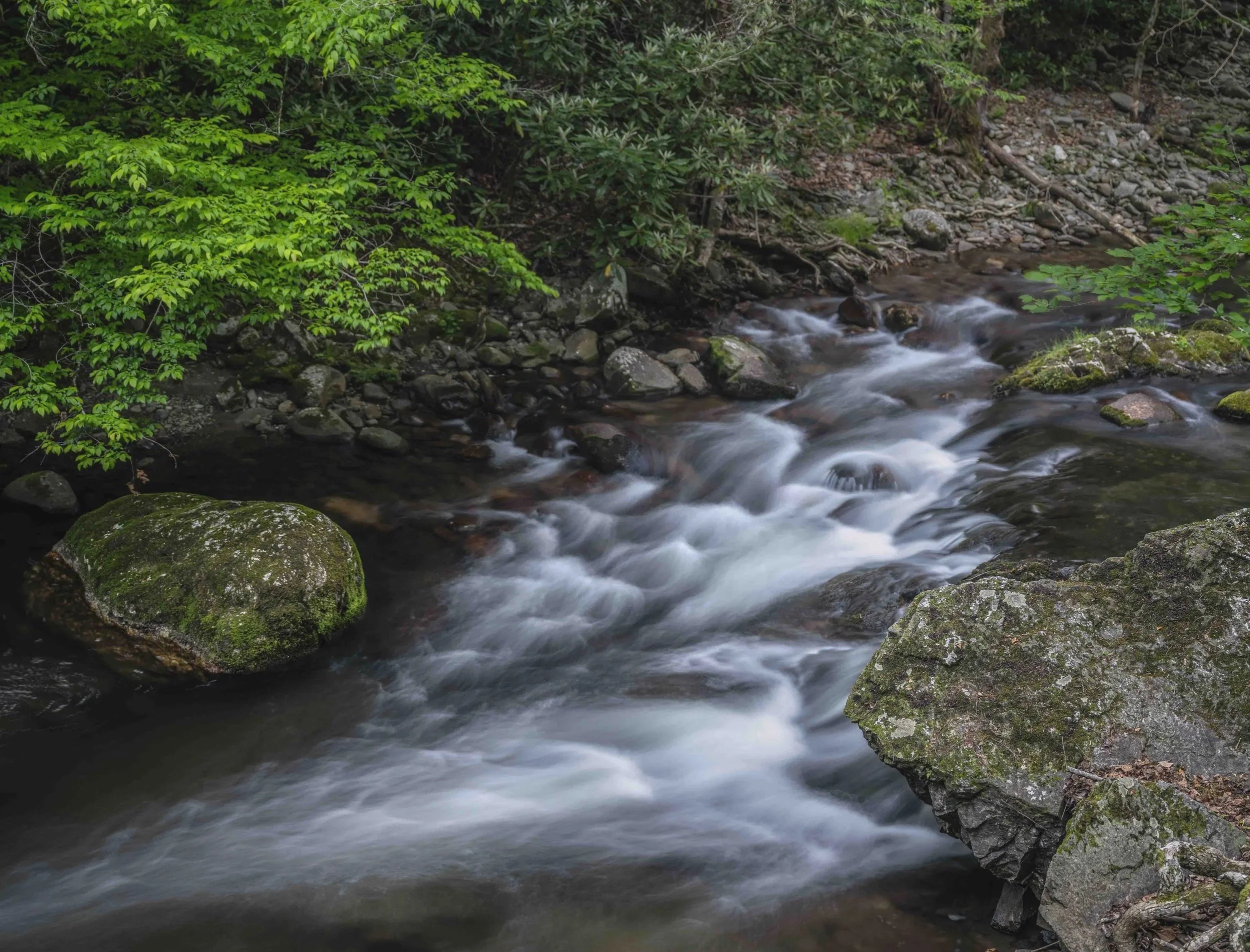
A three-second exposure turns rushing water into silk. One of the Smokies' countless mountain streams, slowed down to a whisper.
The Smokies are laced with rivers and creeks, the Little River, Oconaluftee River, and countless smaller tributaries. One of the most satisfying techniques to learn here is turning fast-moving water into something smooth and almost dreamlike.
The effect comes down to shutter speed. A fast shutter speed freezes water into individual droplets and splashes; a slow shutter speed blurs the water's motion into soft streaks or a silky, cotton-like blur. Here's the basic approach I used throughout the trip:
Mount your camera on a tripod. This technique requires exposures long enough that handholding simply isn't an option.
Choose your shutter speed based on the look you want. Around 1/4 to 1 second gives you visible motion with some texture retained in the water. Longer exposures of 2–5 seconds (or more) smooth the water out almost completely, especially in faster-moving sections.
Use a low ISO and a narrow aperture (f/11–f/16) to help achieve a slow enough shutter speed, especially in daylight.
Add a neutral density (ND) filter for bright conditions. Midday sun makes it nearly impossible to get a slow enough shutter speed without one, since even your narrowest aperture and lowest ISO won't cut enough light on their own.
Use a remote shutter release or a 2-second timer to avoid introducing camera shake when you press the shutter button.
The most forgiving time to try this is on an overcast day, or in the soft light of early morning and late afternoon, when you don't need a strong ND filter to get long enough exposures.
Grand Mountain Vistas
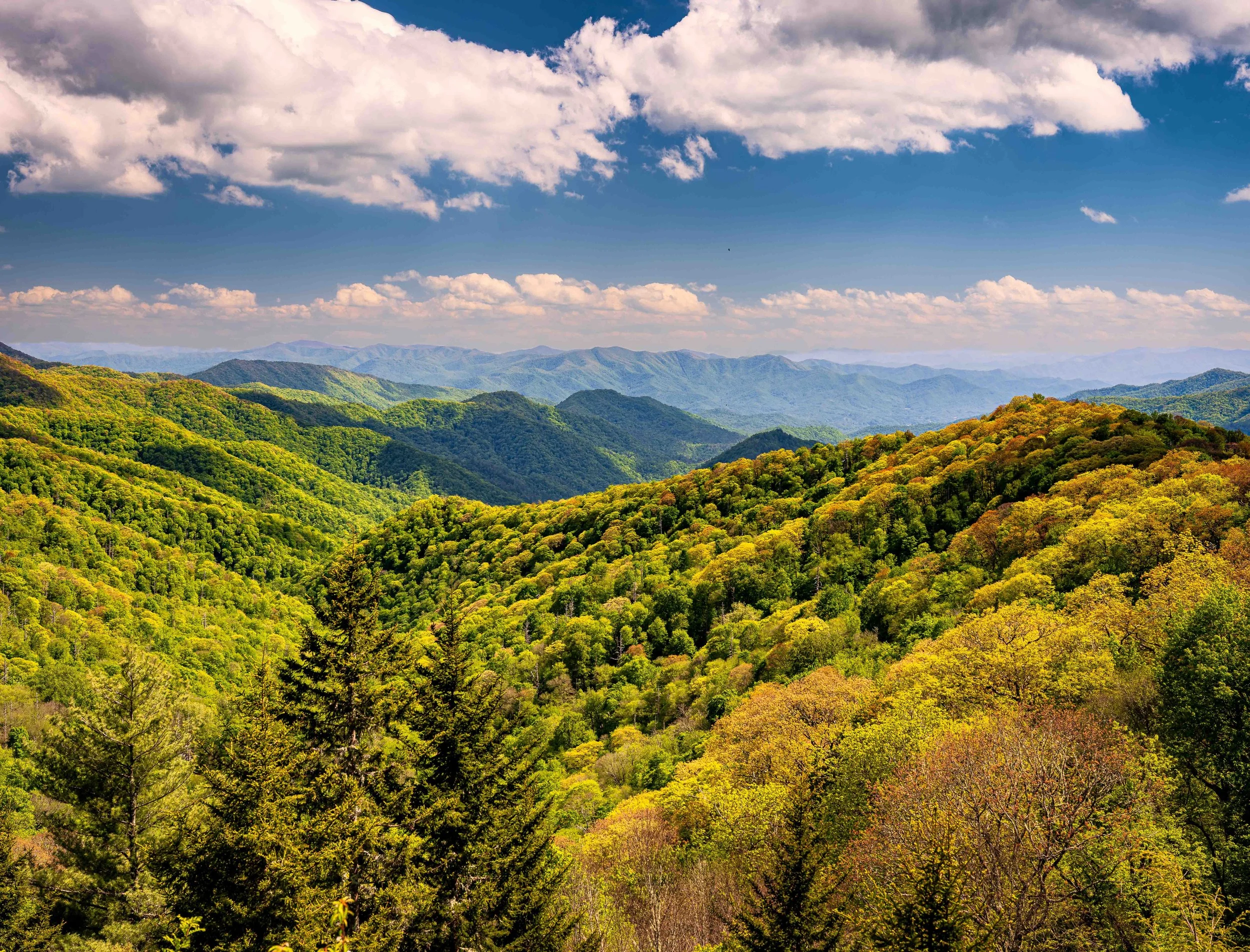
Ridge after ridge fading into blue. The Smokies don't have jagged peaks, they have something softer, and somehow just as powerful.
For all the intimate, close-in subjects the Smokies offer, it's still fundamentally a mountain park, and the big vistas are worth building your itinerary around. Newfound Gap, Clingmans Dome, and countless overlooks along Foothills Parkway all deliver the kind of layered, blue-tinted ridgelines that define this range.
What struck me most, coming from other mountain ranges out west, is how soft the Smokies feel by comparison. There are no jagged, snow-capped peaks here. Instead, the mountains roll and layer into one another, and the atmosphere itself becomes part of the composition. Shooting these vistas well is less about finding a dramatic peak and more about finding strong foreground elements, a lone tree, a bend in the road, a wildflower bloom to anchor the eye before it travels back into the layered ridgelines above.
Golden hour light does incredible things here, raking sidelight across each ridge and separating them into distinct tonal bands. It's worth scouting your vista during the day and returning at sunrise or sunset once you know exactly where you want to stand. This image appears to be a fall scene but actually it is the new growth on the trees and the way the light is accentuation it.
Wildlife: Life Among the Ridgelines
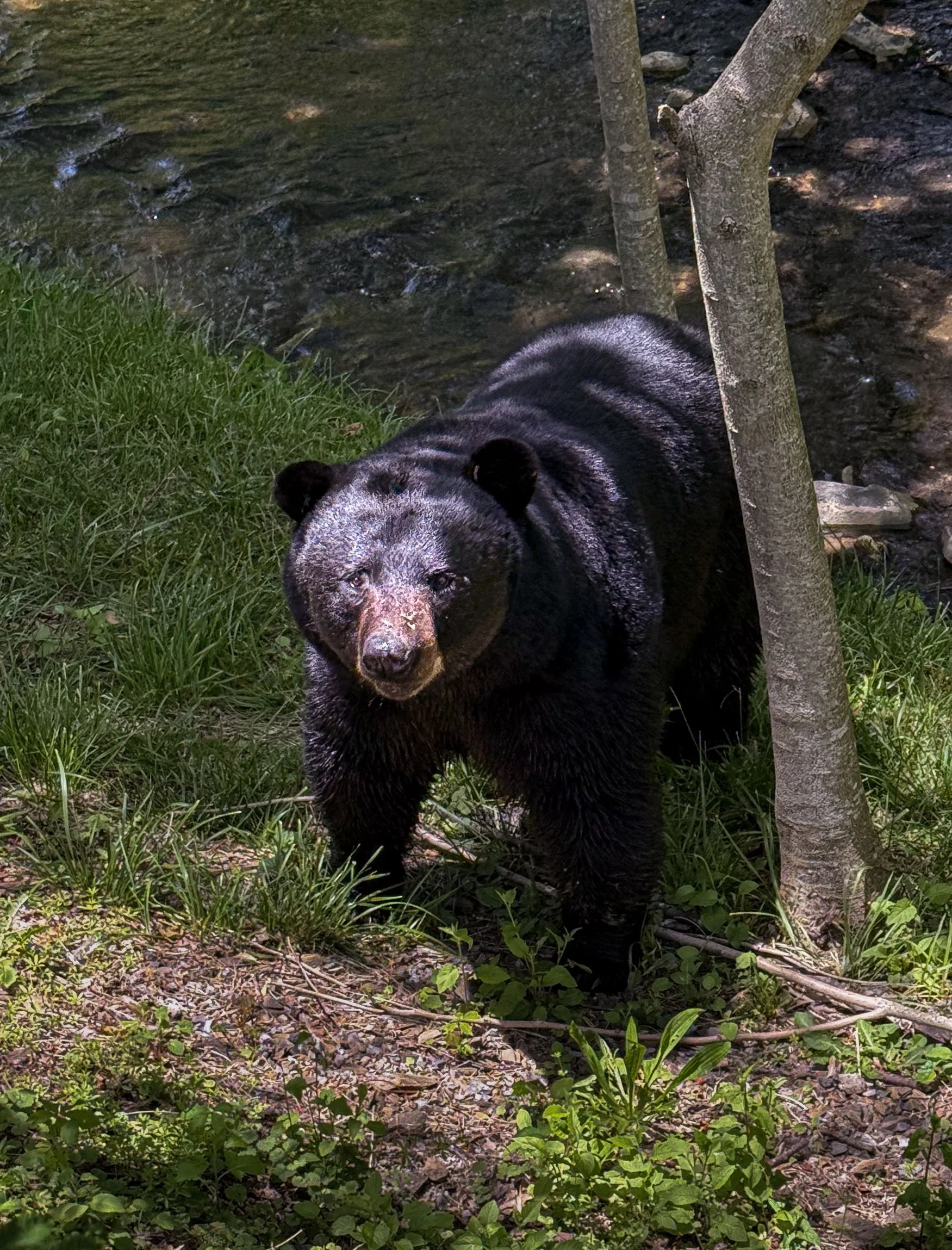
A Smoky Mountain black bear — a quiet reminder of just how wild this park still is."
With such dense, protected habitat, the Smokies are one of the best places in the East to photograph wildlife, and black bears are the headline act. I was fortunate to photograph a few bears foraging in open meadows near the tree line or by the rivers edge during my trip. A reminder of just how healthy this park's bear population is.
A few notes on responsible wildlife photography here:
Keep your distance. Park regulations require staying at least 50 yards from bears at all times, both for your safety and theirs. Bears that become habituated to humans often have to be relocated or, tragically, euthanized.
A telephoto lens is essential, not optional, for wildlife work in the Smokies. A 300mm or longer lens lets you fill the frame respectfully from a safe distance.
Early morning and evening are prime times, when bears and deer are most active and the light is at its best.
Beyond bears, keep an eye out for white-tailed deer in Cades Cove, wild turkeys, elk in the Cataloochee Valley, and an enormous variety of songbirds throughout the forest.
Final Thoughts
Six days wasn't nearly enough. Between the fog-draped mornings at Cades Cove, the quiet discovery of Cane Creek Twin Falls, and the simple thrill of watching a black bear move by the river, the Great Smoky Mountains earned their reputation with me many times over. If you're planning your own photography trip here, build in more time than you think you need. The light changes by the hour, and this park rewards patience more than almost anywhere else I've photographed.
Comments are always welcome.
You can see more images from the Great Smoky Mountains National Park on my website at the following link.